Sense and Sensibility (2026) Review: In the Age of Yearning
Film & TVFilm & TV2 October 2026
AuthorIsabelle Monteiro
PhotosPhoto credit: Focus Features
A melancholy reimagining of Austen that finds new life in the old pleasures of restraint, romance and longing
J
ane Austen’s debut novel paints a portrait of two sisters who embody qualities of reason and restraint against emotion and impulsiveness. Written at the tail end of the Neo-Classical era, Sense and Sensibility conveys the preoccupations of the dawning Romantic literary movement, with its reverence for nature, emotion and the sublime, coloured with romance as we understand it now — longing, yearning and the agonising desire to be loved. Georgia Oakley’s new adaptation is steeped in both traditions.
Earthy and nostalgic, Oakley’s Sense and Sensibility seems less concerned with Austen’s sharp wit and social observation than with the feeling beneath it, stripping it back to something vulnerable and intimate.
Every frame looks like a painting, with long, wide shots placing characters symmetrically against the rural backdrop of the Devonshire countryside. This effect is partially achieved by the film’s use of 35mm film, whose organic grain, soft focus and rich, warm colours give the film a tactile quality that digital cinematography can struggle to reproduce.
There is a tangible softness to the expansive landscapes and quiet interiors, creating a lived-in atmosphere where a single glance speaks more than a page of dialogue.
The film’s aesthetic quality holds traces of Joe Wright’s 2005 Pride and Prejudice in that landscape, physical proximity and natural light are used to externalise romantic feeling. The countryside becomes a space for longing, and each relationship is shaped by the small moments: a look held too long, the ache of being close to someone and still not quite having them.
And this, above all, is a film about yearning.
Perhaps there could be no more fitting moment for a new Sense and Sensibility. We are living in an age of romantic pining. From the literary ecosystem of BookTok to the cultural phenomenon of Heated Rivalry, the yearning man has become collectively embedded in our imaginations.
Oakley’s adaptation understands the appeal as most of the characters find themselves wanting things they cannot have and feeling things they cannot admit.
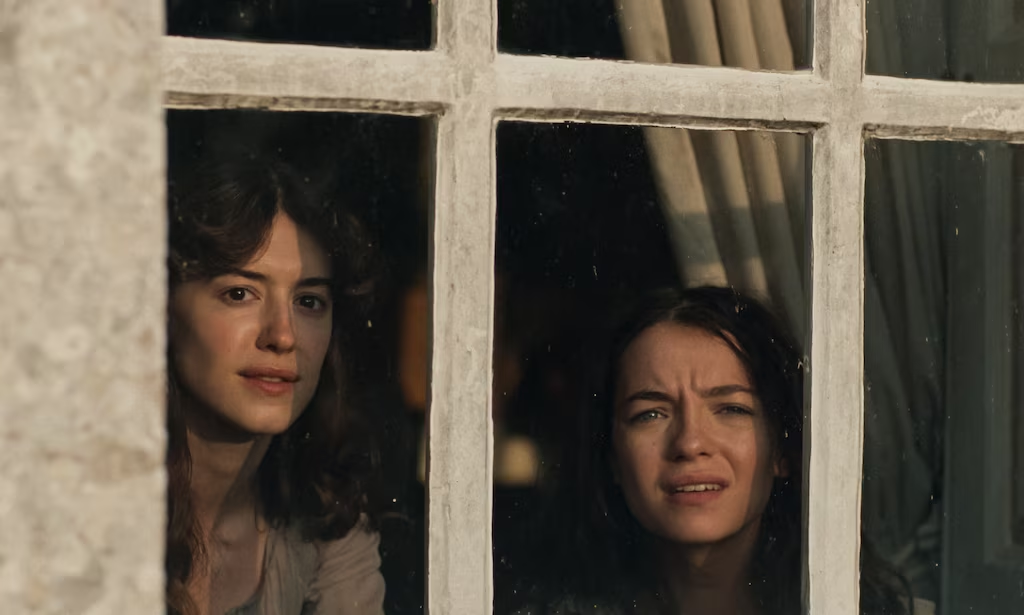
Daisy Edgar-Jones is particularly effective as Elinor, whose emotional restraint is constantly at war with her burgeoning feelings. She gives us a gentle, yet deeply conflicted Elinor, whose silence is never just empty. Her relationship with Marianne further provides the film with its emotional core, and the contrast between Elinor’s desire to protect, absorb and endure against Marianne’s tendency to feel everything openly and easily is no doubt one of the film’s strongest elements.
Fiona Shaw gives another standout performance, with her portrayal of Mrs Jennings providing a welcome burst of comedic relief. Shaw steals almost every scene she’s in and her laugh alone feels like a hilarious antidote to the film’s more solemn moments. In a story that is half preoccupied with restraint, Mrs Jennings’ meddling and unabashed enthusiasm are a welcome dose of levity.
However, it should be noted that this is a particularly somber Sense and Sensibility and is considerably sadder than other Austen adaptations. Its emotional world is saturated with melancholy while Roger Goula’s swooning score reinforces the film’s delicate emotions.
The music gives weight to every glance and hesitation, ensuring even the smallest romantic gesture feels momentous. The effect is undeniably stunning, although this visual sumptuousness threatens to eclipse the emotional intricacies beneath it.
There are moments where the film’s commitment to atmosphere comes at the expense of emotional development. The pacing can be slow, and although its languor often allows us to sit with the characters’ emotions, certain beats feel as if they could have been developed further. At times, the film seems more preoccupied with beautifully depicting a feeling rather than allowing audiences to fully inhabit it, thus sacrificing emotional complexity for visual aesthetics.
This is also where the question of adaptation becomes unavoidable. Oakley’s adaptation may not be as faithful to Austen’s novel as Emma Thompson and Ang Lee’s 1995 film, nor may it necessarily be a film for Austen purists.
However, Oakley’s Sense and Sensibility feels like an interpretation rather than a reproduction. It takes the emotional architecture of Austen’s novel—the yearning, sisterhood, the romantic frustration and comedy—and translates it into a distinctly contemporary visual and emotional language. This adaptation filters Austen through modern sentiments without losing sight of the melancholy of the original.
Perhaps that is why, despite its occasional shortcomings, the film is so easy to fall for. Made for an age that has developed an insatiable appetite for yearning, this film is romantic in both the literary and modern sense of the word, finding something timeless in the quiet anguish of wanting what we cannot have.