Corita Kent: Religion, Art and Movement
Culture1 October 2026
AuthorNaz Sakici
Meet Corita Kent, the nun whose bold Pop Art brought together faith, political protest and the fight for equality.
‘
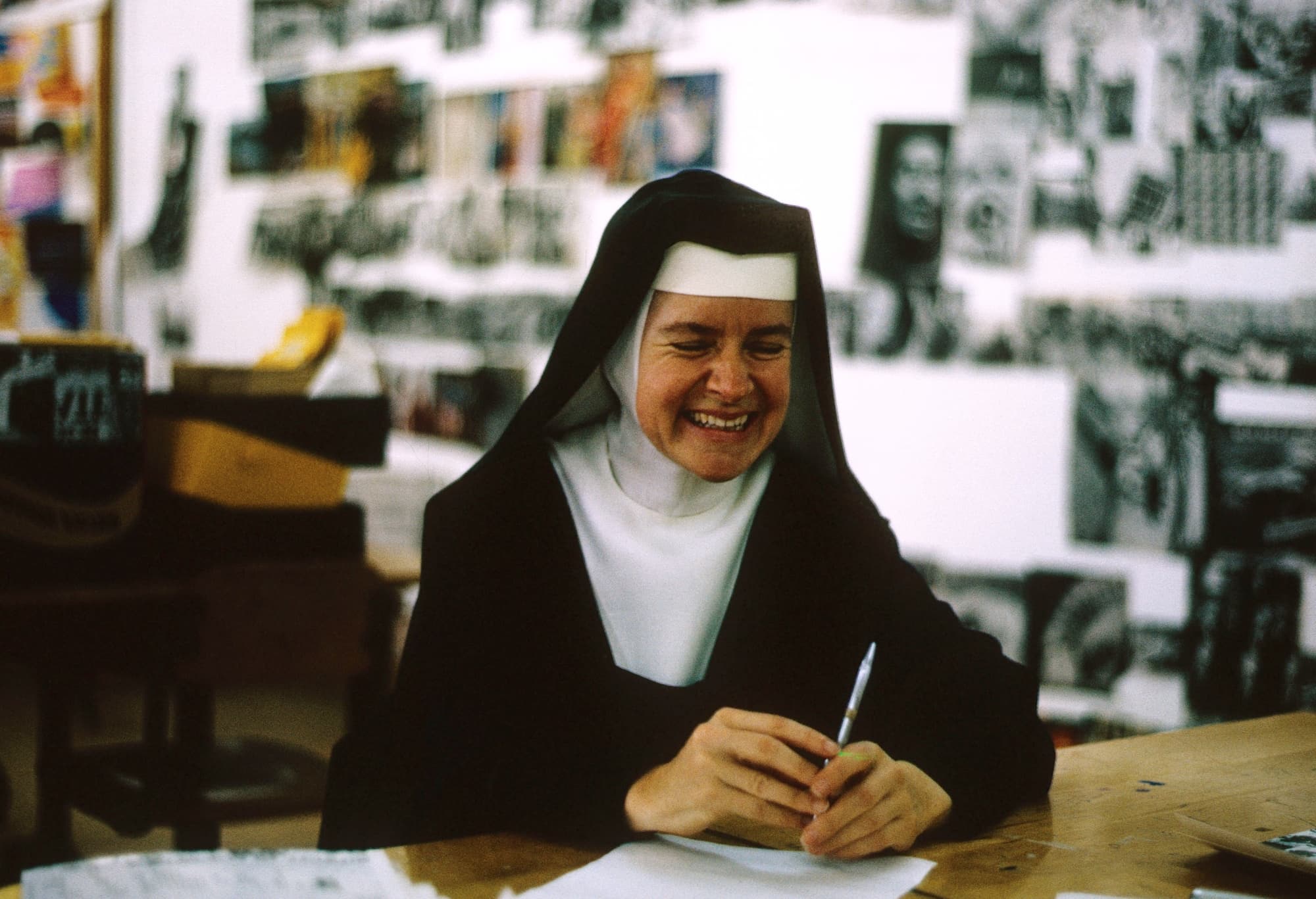
‘We are breaking all the rules, even our own rules’’ was the last one out of the 10 rules Sister Mary Corita Kent followed in her class as she became one of the most prominent names of Pop Art with her daring social and political pieces that caught the attention of the Catholic Church and many others who found her views controversial.
Frances Elizabeth Kent was born on November 20, 1918, in Fort Dodge, Iowa. As she entered the Roman Catholic order of IHM, she changed her name to Sister Mary Corita, which means ‘‘little heart’’. At 18 years old, Corita Kent joined Sisters of the Immaculate Heart, a religious teaching institute for women, and got her bachelor’s degree at Immaculate Heart College in Los Angeles, later getting her master’s degree at the University of Southern California. After completing her education, Corita Kent went back to Immaculate Heart College and started teaching art there, eventually becoming the chair of the art department.
Corita Kent’s artwork mostly consisted of serigraphy, also known as screen printing, in which the artist pushes the ink through a mesh screen onto a piece of fabric or paper. For Corita Kent, her personal print choice was silk, making her pop-art style work stand out with the unique canvas as she was trying to find beauty in all aspects of life, while she made bringing joy to people her duty as an artist.
At the start of her career as an artist, she first started working on religious themes in her art, as people around her would describe her as a ‘‘deeply spiritual woman’’. As her art career expanded during the 1950s, Corita Kent started adding political themes to her work to bring messages about social justice and civil rights for the public to view.
In the 1960s, Catholic leaders gathered to discuss the church's rules and adjust them into the twentieth century at the Second Vatican Council. This resulted in the members of Sisters of the Immaculate Heart reconsidering their own religious practices, starting to question the hierarchy of the church. With this change, the sisterhood started becoming more engaged with political causes, participating in protests against police brutality, injustice towards workers’ rights, and the Vietnam War. They even marched together with Martin Luther King Jr. in Alabama, causing them to become known as avant-garde nuns in the public eye.
As her sisterhood was fighting for social justice, Corita Kent’s art was evolving into what it is famous for today, revolving around her perspective on race, wars, and injustice. She even went on to create artwork for social justice and anti-war organizations with slogans such as ‘‘We can create life without war.’’
In 1964, she made perhaps one of the most prominent and controversial religious works of her career titled ‘‘the juiciest tomato of all’’ in which she describes Mary, mother of Christ, with that phrase, which was inspired by the brand Del Monte. Even though the artwork depicts Mother Mary as perfect and glorious with all her beauty, Cardinal McIntyre, Archbishop of Los Angeles, found the work’s wording sexual, banning it from public display.
Even after her passing in 1986, Corita Kent’s legacy continues to live with many artists and activists. She influenced the Pop Art movement not only as an artist, but also as a religious figure who thought outside the box. Her artworks and her impact can be seen at Corita Art Center, which is an organisation that archives her work and supports exhibition loans.