Jason Caceres wants the murder, the mystery and the mess
Film & TV19 October 2026
AuthorIsabella Pettitt
PhotosPhotography: Bryan Schaub
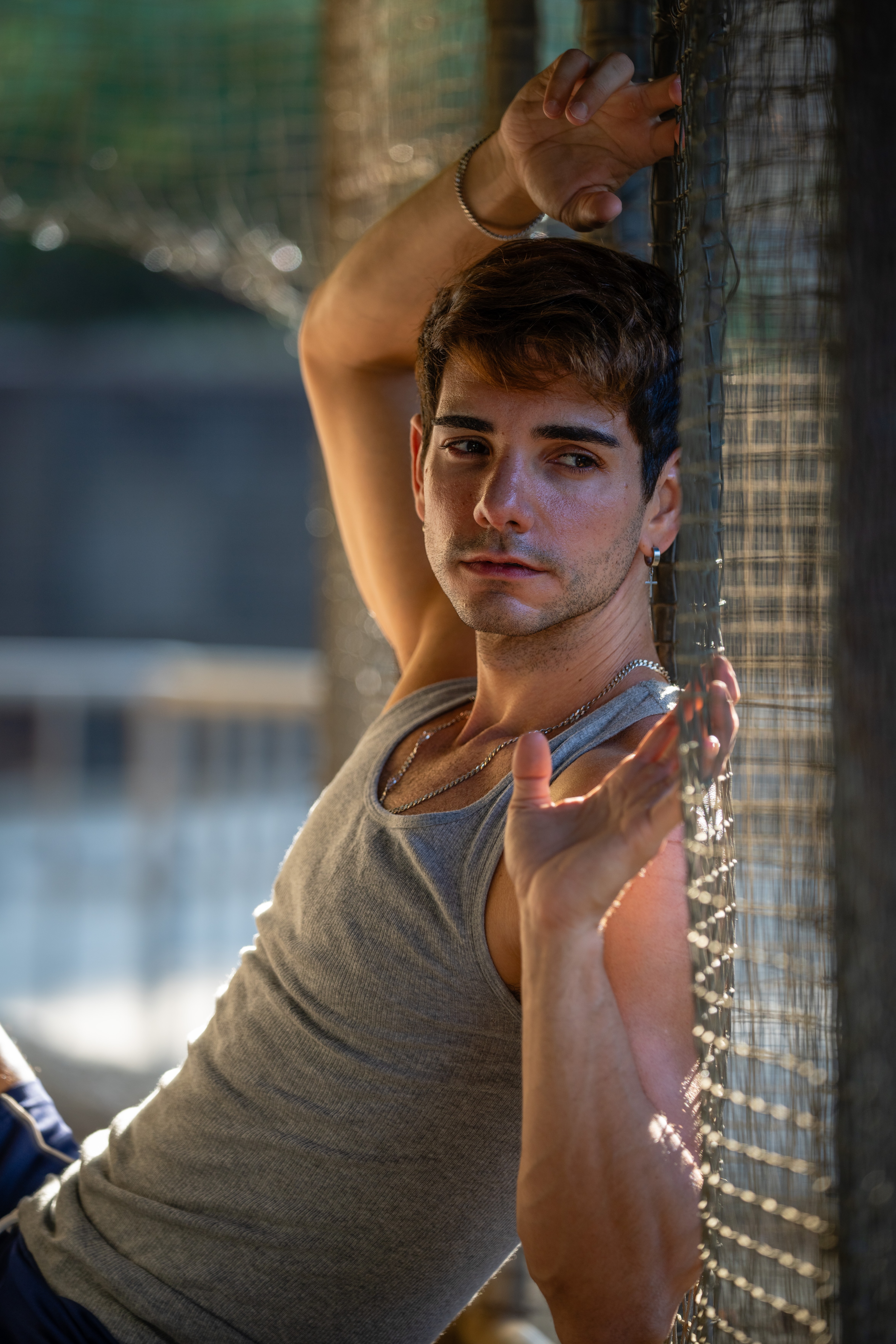
Jason Caceres talks queer joy, Laid Bare and making space for himself in Hollywood, without toning himself down.
I
've been making my way through Hacks recently, so when Jason Caceres first landed in my inbox and I began doing the obligatory scan through his previous work, one credit immediately jumped out at me. Hacks. Okay, I thought. We're dealing with a big deal here.
Admittedly, Caceres' appearance in the show is a small one, but looking beyond it quickly revealed a career far more expansive than a single television credit could suggest. The Cuban-American actor has moved between comedy, drama and unapologetically queer storytelling, with roles spanning Boy Culture: Generation X and Open To It to his most recent project, OUTtv's murder mystery Laid Bare. And acting is only part of it. He's modelled, holds an MBA alongside fitness and nutrition credentials and, because apparently there weren't already enough strings to his bow, is now stepping behind the camera as a producer.
Below, Jason Caceres talks Laid Bare, queer joy, accidentally becoming a model, building his own damn table in Hollywood and why, as far as he's concerned, he may have already peaked.
You’ve spoken beautifully about how your Cuban American heritage and your family’s immigrant work ethic shaped you. How do those roots inform the way you navigate Hollywood, especially as a queer actor claiming space in the industry?
JC: Growing up in Miami as the son of Cuban immigrants meant I was constantly straddling two cultural worlds. At home, I spoke Spanish, watched telenovelas, and ate croquetas and bocaditos, while at school, I spoke English and ate mac and cheese. That duality gave me a deep sense of empathy that I bring to every character I play.
Beyond that, my parents instilled a relentless work ethic in me. You don't leave everything behind to start over in a new country without a massive amount of hustle. I bring that same immigrant grit to Hollywood. Being a queer, Latino actor means the doors aren't always wide open for you. The industry wants a specific stereotype, and I just don't fit it.
So, my heritage reminds me that if there isn't a seat at the table for me, I have the power to pull out a hammer, build my own damn table, and invite whoever I want to sit with me. Although, I’d probably leave the heavy building work to my partner. He’s much handier than I am.
Laid Bare is making waves as OutTV’s first scripted series, leaning into unapologetic, bold queer representation. Why do you think it’s so vital right now to see queer stories that are messy, complex, and entirely unfiltered, rather than sanitized for mainstream palates?
JC: For so long, queer representation in media was heavily sanitized to make us "palatable" to straight audiences. We were relegated to the quirky best friend, the punchline, or the tragic victim. Laid Bare, which is this incredibly fun, queer Agatha Christie-style murder mystery, flips that on its head. It’s vital to see messy, complex, and unfiltered queer stories right now because that’s what humanizes us.
We are allowed to be flawed, hilarious, emotional, and intensely desired. When we only show sanitized versions of ourselves, we strip away our authenticity.
I want audiences to see us making mistakes and living out loud, because portraying queer characters with that kind of unapologetic joy and chaos is exactly where our storytelling needs to go. Give us the murder, the mystery, and the mess!
You have such a fascinating, multi-hyphenate background: you’re an actor, a model, and you also hold an MBA alongside fitness and nutrition credentials. How does this diverse perspective give you a unique edge or shape your work ethic when you’re on set?
JC: Having an MBA and understanding the business side of "show business" fundamentally changes how you operate. I don't just look at a project creatively anymore. I understand the logistics, the marketing, and the sheer momentum it takes to get a production across the finish line.
Meanwhile, the fitness and nutrition background brings a level of discipline that is absolutely essential for the grueling hours on set. Acting isn't just an emotional exercise, as many of my colleagues know, it’s a highly physical one. My diverse background keeps me grounded and analytical in my preparation, so that when the cameras roll, I have the stamina and the foundation to completely let go and just play.
You’ve mentioned that your modelling career started somewhat accidentally through friends, but it has clearly become a major part of your creative brand. How does the physicality and visual storytelling of modelling inform your on-screen acting, and vice versa?
JC: It really did start by accident! I just had very talented friends who needed a subject, and I figured, "Hey, free photos." But it quickly turned into this incredible masterclass in visual storytelling. Modeling is essentially acting without dialogue. You have a split second, a single frame, to convey an entire mood, story, or emotion using only your body and your eyes.
That hyper-awareness of physicality translates directly to how I move on camera as an actor. It teaches you how to find your light, how to use stillness to your advantage, and how to tell a story with a simple shift in posture.
Conversely, my acting background makes my modeling much more dynamic. I'm never just standing there posing. I'm always thinking about the internal life of the character I'm embodying in that specific shoot.
You’re currently promoting both the bold, scripted murder-mystery world of Laid Bare and the scripted Indie comedy Open To It, which explores modern relationship dynamics. How do you shift your creative mindset when moving between these very different tones and formats?
JC: The whiplash is very real! One day I’m brooding in a corner trying to figure out who the killer is and the next day I’m delivering some quip about my character’s last hookup while trying not to break character and laugh. It's all about finding the core truth of the character and then adjusting the dial on the world they live in.
Open To It is, at its heart, a sex comedy that is meant to make you giggle. It requires a lighter, more campy energy where you can rely on a perfectly timed eye-roll or a sharp one-liner. Laid Bare demands a completely different kind of tension and stakes, given the murder-mystery element.
But whether I'm leaning into absurdity or navigating the suspense of a thriller, the foundation is always empathy. I trust the script, rely on my directors, and let the specific environment of the set dictate the energy I bring to the performance.
You’ve previously shared that Q. Allan Brocka’s original Boy Culture was a "gay awakening" for you, and now you’re starring in Boy Culture: Generation X. What does it mean to you to now be contributing to the very queer cinematic canon that helped you understand your own identity?
JC: It is genuinely surreal. When I first moved to Los Angeles to pursue acting, I was starving for stories and characters that were like me. The original Boy Culture was absolutely my gay awakening. It was one of the first times I saw queer life depicted with such candid, sexy, and unapologetic energy. I remember being a closeted kid, watching the original with the volume turned down low so my parents wouldn't hear, just absolutely captivated by seeing gay men on screen who were confident, sexy, and completely unashamed of who they were.
To be cast in Boy Culture: Generation X and to work alongside Allan Brocka felt like the ultimate full-circle moment. Becoming part of the very creative lineage that helped me accept myself is the greatest gift of my career. Honestly, I’ve peaked. I can retire now.
In the past, you’ve shared a powerful story about an early agent asking you to take "accent reduction" classes to get rid of the "gay in your voice," and how you firmly rejected that toxic expectation. How has holding onto your authentic self shaped the kinds of roles and projects you’re drawn to today?
JC: That was a defining moment for me. When she first told me to take accent reduction classes, I honestly thought she meant I had a Miami or a Latin inflection. When she clarified that it was to "get rid of the gay" in my voice because it wasn't "marketable," I was floored. It hurt deeply, but it also forced me to make a choice. Do I shrink myself to fit an antiquated, toxic industry standard, or do I lean into exactly who I am? I fired her and chose the latter.
Holding onto my authenticity is exactly why I thrive in, and fiercely love, the indie queer space today. I am drawn to projects that celebrate our specific voices rather than policing them. I never want to be "palatable"; I want to be truthful.
You are now stepping behind the camera as a producer, currently developing two features with Derek Zemrak. What motivated that shift, and what specific types of stories are you most eager to champion and greenlight from the producer’s chair?
JC: As an actor, you are usually the last piece of the puzzle. You come in when the world has already been built. Stepping into producing with Derek Zemrak gives me the agency to help build the world from the ground up. The shift was motivated by a desire to have a louder voice in the types of stories being told.
From the producer’s chair, I want to champion projects that center marginalized voices, particularly queer and Latino narratives, that don't hinge solely on our trauma. I want to greenlight joy, comedy, complex mysteries, and nuanced romances. I want to create the opportunities for others that I had to fight so hard to get for myself.
Yes, our struggles are valid, but where are our wild comedies? Where are our sweeping, epic romances? Where are our ridiculous heist movies? I want to champion the fun, the fierce, and the fabulous, and open doors for other creatives who are tired of waiting to be chosen.
With such incredible momentum across television, film, and production, what is the ultimate legacy or the type of impact you hope your work leaves on the next generation of queer creatives who are just starting out?
JC: My ultimate goal is for the next generation to look at my career and realize they don't have to compromise who they are to succeed. I want young queer kids out there, especially those struggling with their identity or being told they aren't "normal," to know that there is a massive, loving community waiting for them and that life truly does get better.
I want my legacy to be one of joy, authenticity, and creating space. If my work makes even one person feel less alone and more empowered to tell their own messy, beautiful truth, then my job here is completely done.