Guns, Gazes and Getting It Up: The Erotics of Violence in The Drama
Film & TVFilm & TV7 October 2026
AuthorFreya McLaughlin
Photos© A24
In The Drama, desire and violence become entangled. We examine Charlie’s gaze, Emma’s past and the uncomfortable fantasy the film asks us to confront.
“
Is it hot that I find a fianceé with a past involving guns…kinda hot? Let’s not unpack that today.” (Men’s World India)
It is, admittedly, a horrifying question — but one that neatly captures the moral dilemma at the centre of Kristoffer Borgli’s controversial film The Drama (2026). The quote from Men’s World India embodies the strange moral tension of discovering that someone you are supposed to find horrifying is also, somehow, desirable. While much of the discourse surrounding The Drama asks whether the fantasy of cruelty can be forgiven, the film interrogates something far more uncomfortable: why is the fantasy of violence… kinda hot? We are going to unpack that today.
A few days before their wedding, the seemingly ideal couple Emma (Zendaya) and Charlie (Robert Pattinson) uncover a dark secret from Emma’s adolescence: as a teenager, she planned a school shooting but ultimately did not carry it out. This revelation not only destabilises their relationship, leaving Charlie to question whether Emma is the same person he fell in love with, but has also sparked the predictable black-and-white online debates surrounding Emma’s morality. Crucially, however, The Drama refuses to provide a definitive answer to this discourse, settling itself in the obscured and uncomfortable territory within the morality spectrum.
While Emma is subjected to scrutiny by the characters around her and social media, there is another character whose righteousness shields him from the same examination: Charlie. On paper, Charlie is the person we, as an audience, are supposed to root for. He is sympathetic, anxious and understandably overwhelmed by the existential nightmare that he has suddenly been dropped into.
However, the more he interrogates Emma’s ethics and reasons, the more one has to question whether Charlie is quite as morally innocent as he believes himself to be. While Emma’s morality is placed under a microscope, Charlie becomes increasingly convinced in his attempts to decipher how morally compromised his fiancée actually is. He is horrified by her teenage school shooting fantasy and seems more convinced that this revelation tells him everything he needs to know about her. And yet, strangely, his moral principles appear to have a very convenient intermission whenever sex is involved.
After days of trying to explain herself to Charlie, Emma attempts to initiate an intimate moment with him. The situation escalates physically, but the tension between them is suffocating, their awkwardness seeping into the intimacy. Charlie struggles to become physically aroused, his mind clearly clouded by what Emma has revealed. Despite this, he remains desperate to continue, overriding Emma’s obvious disinterest and emotional distance.
What is especially striking in this moment is his inconsistency. If only he put even a fraction of the effort he spends trying to get hard into understanding Emma’s clearly troubled past. This contradiction is arguably more interesting than the sex itself. Charlie has no problem slamming the brakes on their marriage because of Emma’s history, but when it comes to his desire, his righteousness suddenly becomes much less certain.
Marriage? Suddenly, he is the morality police. Sex? Apparently, no moral line is dark enough to stand in the way of sexual gratification. Priorities, I guess.
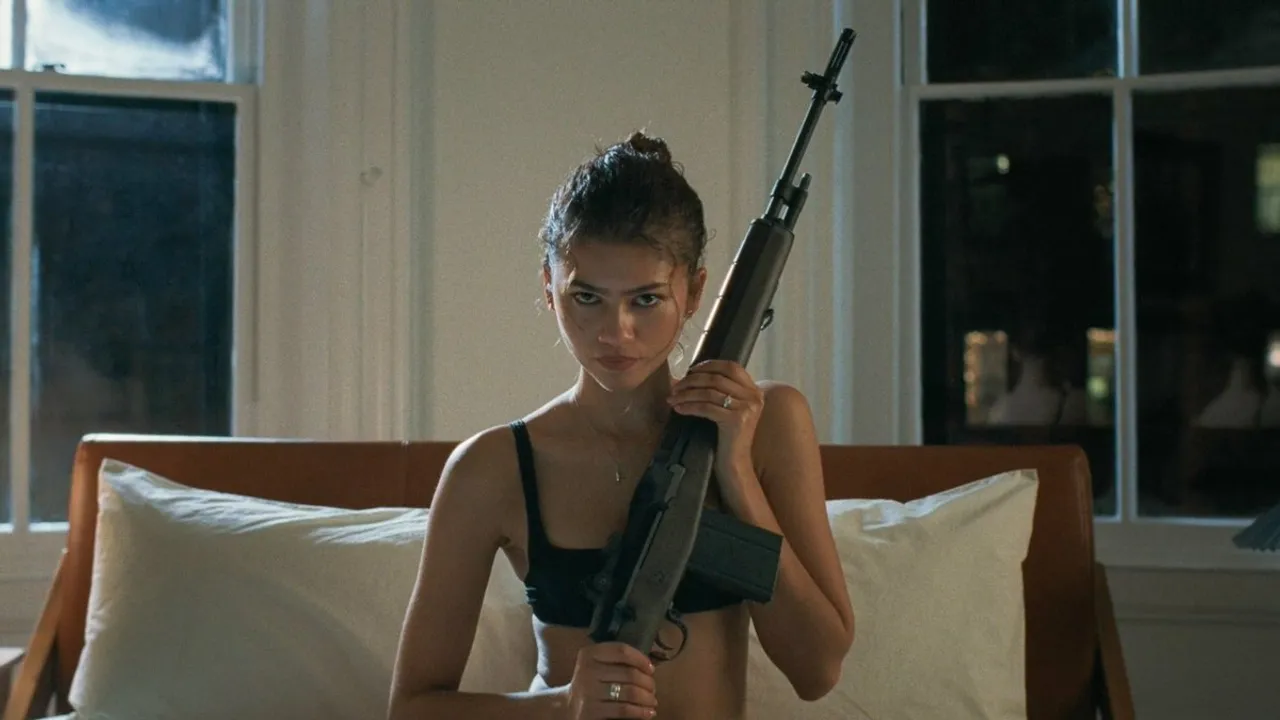
In this moment, Charlie’s sexual desire becomes particularly uncomfortable because it is entangled with the image of Emma as a potential perpetrator of violence. As American psychoanalyst Jessica Benjamin argues in The Bonds of Love: Psychoanalysis, Feminism, and the Problem of Domination, “the fantasy of erotic domination… permeates all sexual imagery in our culture.” Benjamin’s theory reverberates throughout the film, both in this scene and, more disturbingly, later, when Charlie imagines Emma propped up in their bed, laced in lingerie and holding a rifle. This image embodies the version of Emma Charlie has constructed in his mind, the woman he is trying so desperately to desire, now fused with the violence he cannot stop thinking about. It is here that the film’s two central themes — sex and violence — begin to overlap.
This intersection becomes pivotal as the film begins to examine the fantasy of violence through Emma, who is, after all, both a product and a victim of such imagery. As a teenager, she falls prey to the aestheticisation of gun violence, consumed by the mythologised image of the school shooter and drawn into a fantasy of violence against herself and her peers. Although she ultimately does not enact such violence, The Drama is less interested in the act itself than in the broader cultural fantasy that makes violence so seductive in the first place.
It is this societal aestheticisation that exploits Emma’s turmoil, transforming her vulnerability into a desire to commit a horrific act rather than seek help. An art exhibition book in Charlie’s office, titled Brainrot, makes this connection more clear, containing images of women in lingerie posing with firearms, their eroticised bodies merged with weapons designed to kill, all presented for visual consumption. As Charlie flips through the pages, he begins to imagine Emma amongst the models, further establishing her as this symbol of fantastical violence. These pictures turn violence into something seductive, collapsing the distance between what is meant to horrify us and what we are invited to desire.
Although Emma ultimately reforms, choosing not to carry out the school shooting and instead advocating for gun control in America, she never entirely escapes the eroticisation of violence, even as an adult. Instead, it is the seemingly innocent and righteous Charlie who keeps her trapped within this cycle of sexualisation. In his imagination, Emma poses on their bed, almost naked, caressing a rifle; she is presented not simply as a woman, but as a weapon and a fantasy.
Film theorist Laura Mulvey identifies this dynamic through the cinematic male gaze: “woman as image, man as bearer of the look.” In this framework, women are constructed as objects of visual consumption. Emma becomes precisely this kind of object for Charlie. He no longer sees her simply as Emma, but through the violent fantasy she once confessed to imagining. The sexualising of his fiancée through his gendered gaze makes the irony of that Men’s World India quote difficult to miss.
It is important, however, to distinguish between Emma’s own desires and the erotic meaning Charlie projects onto them. Emma is not inherently salacious when she initiates sex with Charlie, nor when she imagines shooting up her school. In both moments, she is desperate, covertly calling for help from those around her to listen, understand and recognise her despondency.
Instead, Charlie transforms her violent potential into something erotic, submerging her sexuality into the illusion he has constructed around her hypothetical violence. He conceptualises her differently because of what he has discovered, and the film invites us to do the same. After all, Mulvey describes woman as the “erotic object for the spectator.” Emma occupies this position not only for Charlie, but for us, the viewer. And that is where the film becomes particularly uncomfortable. Are we only looking at Emma through Charlie’s gaze? Or is it our own?
This is where The Drama becomes more than a story about a couple’s impending wedding disaster. It becomes an examination of the disturbing reality that violence, sex and fantasy are far less separate than we like to believe. We like our violence fictional, aesthetic, confined to online disputes. We like to believe that we are horrified by it while continuing to consume it.
The film makes this contradiction almost embarrassingly explicit when Charlie flips through the images of models posing with guns. The fictional art book even spells out the very argument the film is making, describing how “the aestheticised violence depicted in films and mirrored in fashion can create a troubling cycle, where the glamourising of aggression is internalised.” But I doubt many viewers paused the movie to read the description.
We were probably too busy watching the far more visually enticing possibility of the beautiful Zendaya scandalously caressing an AK-47. The irony is almost painful. The Drama highlights that we are susceptible to the eroticisation of violence while simultaneously giving us a spectacle designed to distract us.
And that is the trick The Drama plays on its audience. It does not simply ask us to condemn Charlie for sexualising Emma’s violent past. It implicates us in the same act of looking. We watch him look at Emma, and share his gaze as we look at her too. The film’s critique of voyeurism becomes, itself, an exercise in voyeurism. We are horrified by the image, but cannot help but watch it. Perhaps the real question is not whether violence can be erotic, but more why we are so capable of sexualising it in the first place.
The disturbing reality about The Drama is not that Emma once fantasised about violence nor that Charlie finds this connection to violence “kinda hot.” It is that The Drama makes us confront how easily we can become complicit in the same fantasy.
So, is it hot that we find a fiancée with a past involving guns… kinda hot?
By the end, The Drama has made this question much harder to dismiss. Because perhaps the film’s most disturbing fantasy isn’t Emma’s.
Maybe it is ours.


