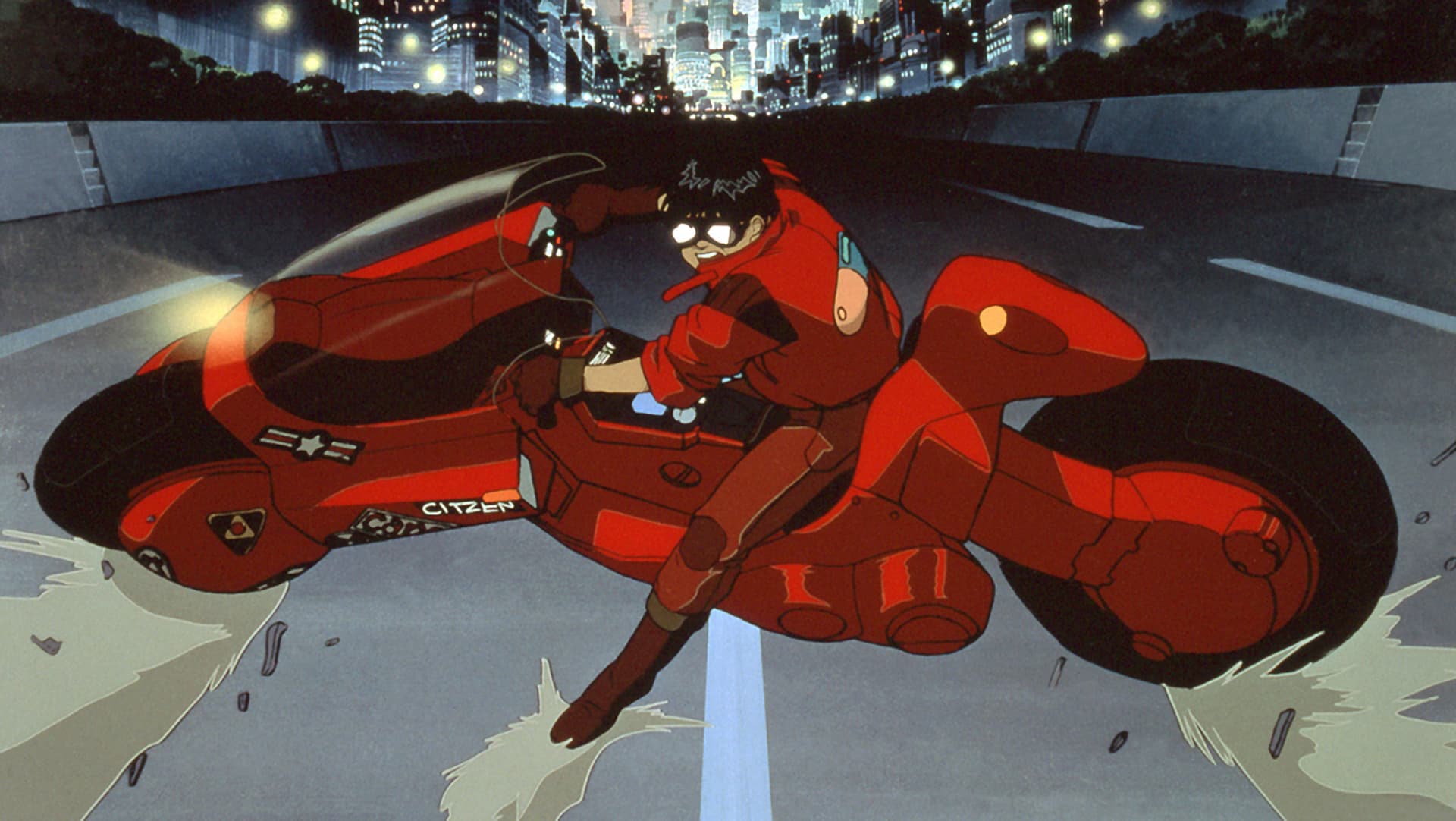
Akira (1988) Returns to UK Cinemas: Does Its Revolutionary Vision Still Hold Up?
Akira returns to UK screens 40 years on, but does its revolutionary violence speak to us today more than it could have predicted?

By Alexandra Hill
A
lmost four decades after its release, Otomo Katsuhiro's Akira (1988) has struck its red hue across UK screens once more, reintroducing the anime feature-length film for modern audiences just last month.
In his first feature, Katsuhiro establishes a post-apocalyptic image of Neo Tokyo in 2019 after the Third World War of 1988—a city that has already fallen under oppressive military rule. Marked by civil unrest, terrorism, political protest and rival youth gangs—but also the overall techno-cyberpunk coolness of the animation—Akira carefully treads the line between utopic and dystopic visions of both past and modern society.
Across its 700 scenes drawn on 160,000 hand-painted cels, we follow one of our teen protagonists Tetsuo, a timid biker teen who due to a biking accident, gains psychic powers and rises to become a part-human, part-Godzilla, all-body horror creature. We never really know who or what “Akira” is, until (no spoilers) we reach Tetsuo’s monstrous transformation at the film’s nail-biting climax.
No surprise, the influence Akira had on 1990s audiences was revolutionary. The Wachowskis cite Katsuhiro’s film as a direct influence on their cyberpunk dystopia The Matrix (1999), while Rian Johnson modelled Cid—the telekinetic child of his sci-fi thriller Looper (2012)—on Tetsuo’s psychic abilities. Kanye West, who now goes by Ye, even entered the world of Akira in his 2007 music video ‘Stronger’, undoubtedly Tetsuo-style.
Still popular nowadays, the psychic child trope also features heavily in the Netflix series Stranger Things (2016-25), whose fame (for better or for worse) has cemented it as a landmark series of the last decade. But this futuristic, albeit supernatural, element is not without its roots in Japan’s repression of a traumatic past.
From the catastrophe of war to rapid modernisation, Japan’s history echoes throughout Akira, creating a film that sits in the past, present, and future. Visual and auditory discontent come alive with two atom-bomb explosions whiting out the screen matched with vividly chaotic body horror.
Not to mention the strange psychic, blue-skinned children, who look and sound just as young as they do 100 years old. While uncanny and definitely disturbing, their role is to sharply convey the tragic past of government experimentation on children—both in Akira-world and wartime Japan. Now frozen in their former bodies while condemned to unimaginable power and immortality, the children serve as an unforgettable reminder of a lost generation.
In Akira, the social, political, and even atomic devastation shows us the extent to which we as humans can (or should) have such power—and the consequences to come.
Saturation to the max, supposedly 327 colours were used on the 70mm film, 97 of them were different shades of red. The blue, sickly-looking skin of the psychic children sits in sharp contrast with Akira’s red: while the children are frozen, almost lifeless, in time, Katsuhiro plays with red in a way that symbolises extreme violence, the power of rebellion, and an unstoppable force of energy. Red for revolution, but can it rebuild from what it destroys?
The dystopic Akira asks if a utopia can finally emerge from the rubble. Nowadays, World War 3 has been knocking on the door for years, with images of flattened rubble landscape in Syria, Ukraine, and Palestine now accessible in everyone’s back pocket. Not so quietly, political protests have flooded our streets salting the air with discontent. It is no stretch to say the society of Neo Tokyo ripping at the seams speaks to our current condition today.
So did Akira predict the future or simply show how history repeats itself? By the time of its release in 1988, Katsuhiro’s 2,000 page manga comic was still unfinished, with the ending still by-and-large in the planning stage. Because Katsuhiro chose one ending for the film, another had to be improvised for the manga. A story unfinished, as is ours.


Cherub Magazine
Subscribe to our newsletter
Conversation
Comments
Loading comments...